Dubai · 20 October 2026
Dubai morning journeys slow as congestion hits key roads
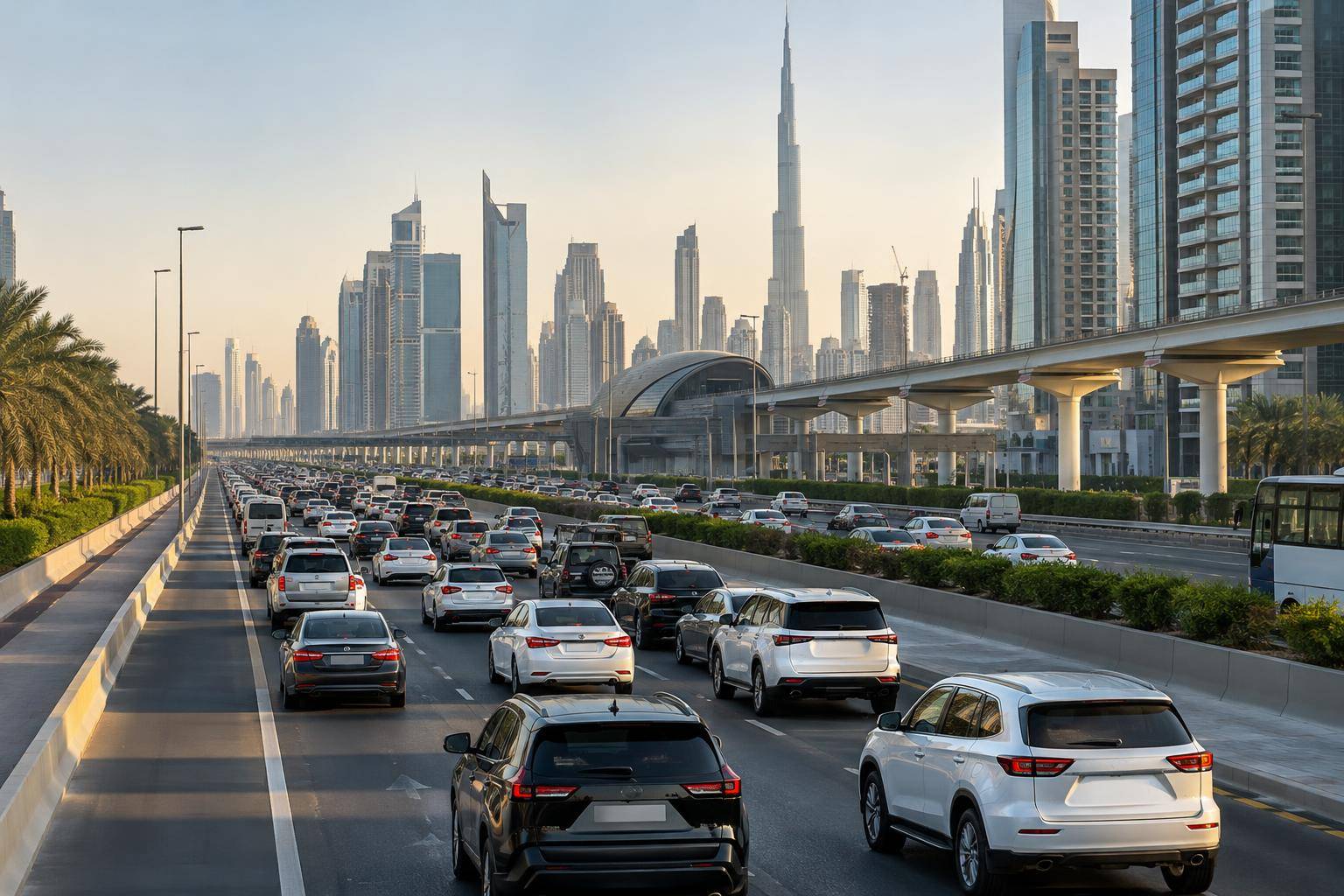
Drivers across Dubai faced congested routes on Tuesday morning, 20 October 2026, with slow traffic around Abu Hail, Muhaisnah, Al Quoz and Jumeirah Village Circle. Gulf News, citing Google Maps in an update published at 07:42, reported delays on parts of three major highways, while most of Emirates Road remained clear.
- Sheikh Zayed Road had heavy queues near Abu Hail and along the Sharjah to Dubai corridor.
- Al Khail Road congestion affected Al Quoz, with further slowdowns near Business Bay and Dubai Design District.
- Sheikh Mohammed bin Zayed Road had delays near Mirdif, Muhaisnah, JVC and Dubai Sports City.
- Emirates Road was largely free of congestion, with mostly clear routes around Dubai Investments Park and approaches to Dubai South.
Quick summary
Dubai's morning traffic picture was mixed rather than uniformly congested. Sheikh Zayed Road (E11), Al Khail Road (E44) and Sheikh Mohammed bin Zayed Road (E311) all had slow sections, but conditions improved along other stretches of those same routes.
Emirates Road (E611) stood out for its relatively smooth flow. The report showed no widespread build-up on its main carriageway across Dubai, making it the clearest of the four highways described.
The update was a snapshot of Tuesday morning conditions, not a prediction for the rest of the day. Drivers were advised to build extra time into their journeys and review traffic before departure. No specific delay durations or expected clearance times were given.
Sheikh Zayed Road: queues in the north, steadier further south
The most pronounced E11 congestion in the report was near Abu Hail and on the corridor linking Sharjah and Dubai. Google Maps showed extended sections of traffic moving slowly in those areas.
Conditions became less congested through central Dubai, although the improvement was not continuous. Al Safa, Umm Suqeim and Al Sufouh were highlighted as places where drivers could still encounter delays.
Further south, journeys through Dubai Marina and Jebel Ali appeared steadier. There were some individual slow sections around major interchanges, but the report did not describe the same lengthy congestion seen further north. For anyone using E11, the relevant stretch mattered more than a blanket description of the whole road.
Al Khail Road: Al Quoz and connecting junctions slow
On E44, Al Quoz and Al Quoz Fourth were among the main pressure points. A section of the highway appeared red on Google Maps, indicating the heavy traffic described in the report.
Drivers also faced congestion around Dubai Design District and Business Bay. Here, the slowdown included connecting junctions, so the approach to or departure from the highway was part of the morning traffic picture.
Elsewhere along the route, Al Warqa and Warsan 2 were affected, particularly at junctions serving travel towards Al Awir. That distinction is useful: while some routes around Al Awir were reported as largely clear, particular connections towards the area still had delays.
E311 and nearby roads: residential exits under pressure
Sheikh Mohammed bin Zayed Road had slower sections near Mirdif and Muhaisnah, alongside congestion on surrounding roads. Further south, traffic built up near JVC and Dubai Sports City, especially at exits serving nearby residential communities.
Motor City also had pockets of congestion, as did connections towards Arabian Ranches. Conditions improved on outer stretches of E311, including those heading towards Dubai South.
The delays were not limited to the main highways. The update identified congestion on Damascus Street (D62), with affected stretches around Al Qusais, Al Rashidiya and Nad Al Hamar. Roads connecting Al Barsha, JVC and Motor City were also slow in places, while a localised build-up appeared near the Dubai to Al Ain Road (E66) interchange.
Why it matters for Dubai
The report highlights how differently a journey could unfold depending on its highway section, connecting junction and destination. A clearer main road did not necessarily mean every nearby approach was moving freely, while a congested highway still had stretches with steadier traffic.
Emirates Road was largely clear, and routes around Al Awir, Dubai Investments Park and approaches to Dubai South were also moving relatively freely. However, the source did not provide comparative journey times or identify a fastest route for individual destinations.
The practical takeaway is to check the complete journey rather than relying on the condition of one named road. Extra travel time remains the source's central advice for motorists travelling through affected areas.
What it means for creators and venues
For creators travelling to venues for Collabs, these locations are useful planning checkpoints. A visit involving Al Quoz, Business Bay, Dubai Design District or JVC could involve one of the slow sections identified in the morning report.
The same planning consideration applies to venues expecting creators to arrive through those areas. Checking the route before departure and leaving additional travel time are sensible ways to apply the source's advice to an arranged visit.
This is a travel-planning implication, not evidence that any particular Collabs were disrupted. The report named no affected venues, creator bookings or cancelled visits. It also gave no basis for assigning a fixed amount of extra time to a journey.
FAQs
When was this traffic update published?
The Gulf News report was last updated at 07:42 on 20 October 2026.
Which major Dubai roads had delays?
Parts of Sheikh Zayed Road, Al Khail Road and Sheikh Mohammed bin Zayed Road were congested.
Was Emirates Road congested?
Most sections were moving freely, with no widespread congestion reported on the main highway.
What should drivers do before leaving?
Check current traffic along the planned route and leave additional time for the journey.
Source: gulfnews.com. Image is an illustration.