Food & Venues · 24 November 2026
Woohoo Dubai puts AI on the menu without taking chefs out of the kitchen
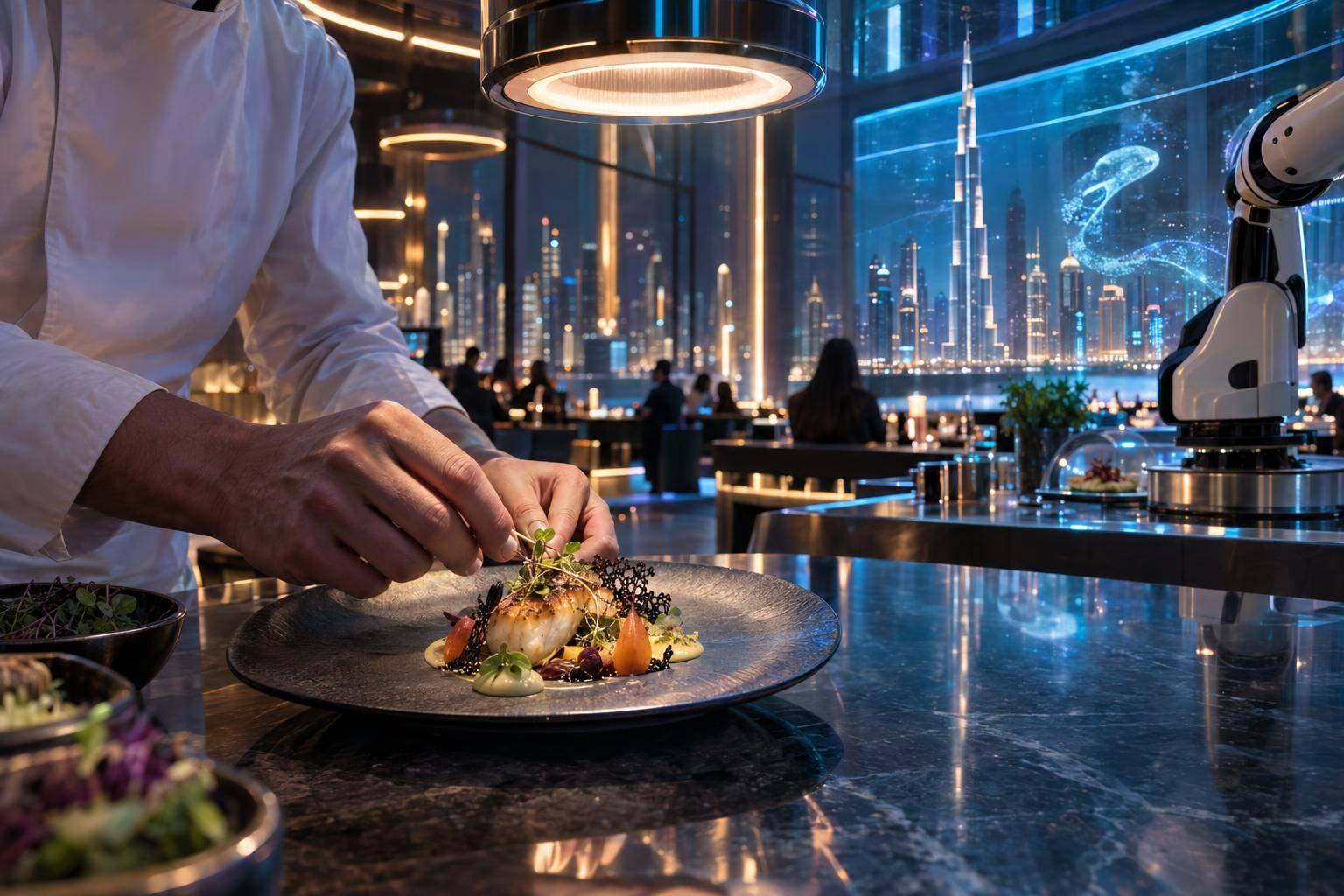
Woohoo, described by Dubai One as Dubai’s first AI-driven restaurant, is the focus of a DXB Today feature uploaded on 23 November 2026. Host Niki visits the cyberpunk-inspired Dubai venue to explore its recipe-making technology, while Nancy Gleason, Professor of Practice in Political Science at MBZUAI, discusses how artificial intelligence and human creativity are meeting in hospitality.
- Woohoo uses AI Chef Aiman to generate recipe ideas that draw on different international cuisines.
- The restaurant says Aiman was supplied with approximately 14,000 ebooks and can produce a recipe in 10 seconds.
- Executive Chef Doğukan Düğüncü describes AI as an assistant for recipe development, purchasing and cost control.
- Human chefs remain responsible for making, tasting and serving the food, rather than handing those tasks to AI.
Quick summary
Woohoo’s proposition brings together a futuristic dining room, an AI culinary character and a kitchen team that turns digital suggestions into food. The Dubai One visit presents the restaurant as an example of technology supporting culinary experimentation, rather than physically replacing the people preparing a meal.
The distinction matters because the phrase AI chef can suggest more automation than the feature actually shows. At Woohoo, Aiman generates ideas and combinations. The chefs still work with ingredients, assess the results and serve diners.
The programme places the visit within a wider conversation about Dubai Future Week, which presenters describe as taking place at the time of the broadcast. Its central question is practical: how can workplaces use AI while retaining the human knowledge that makes their work valuable? For Woohoo, that question begins with developing a dish and ends with whether it works on the plate.
The recipe experiment that started the concept
According to a representative interviewed during the visit, the idea grew from a discussion about finding fresh recipes. The team asked ChatGPT to suggest a dish drawing on Middle Eastern cuisine, and it produced a lamb chop recipe with a saffron accompaniment.
The representative says the resulting dish became a top seller within 10 days. That response prompted a bigger question: rather than using a general chatbot for an occasional suggestion, could the team build a dedicated AI chef around recipe creation?
The account gives Woohoo’s concept a food-led starting point. The initial attraction was not simply putting technology inside a restaurant. It was finding a new route into dish development when the team felt short of ideas.
That reported sales success belongs to the restaurant’s own account in the interview. The feature does not supply sales figures, but it explains why the team considered the experiment worth developing further.
How Chef Aiman develops ideas
Aiman is presented as more than a standard text-based chatbot. The restaurant representative describes an interactive character that people can speak to and see, and that can also see them. He says approximately 14,000 ebooks were supplied to the system.
The example given is a request for a Turkish recipe incorporating British flavours. According to the representative, Aiman can respond within 10 seconds and can bring elements of several cuisines into one proposed dish.
The kitchen team supplies the direction. Rather than allowing the system to settle on a single culinary identity, the chefs ask it to explore the international approach they want for Woohoo. That makes the prompt part of the creative work: people decide what they want to investigate, and AI quickly suggests possibilities.
Speed is the central benefit described here. A generated recipe provides a starting point for experimentation, but it does not remove the work needed to turn an idea into something suitable for guests.
Why the human chef still matters
Executive Chef Doğukan Düğüncü recalls initially treating the prospect of working with an AI chef as a joke. His hesitation came from the physical nature of kitchen work, where touch, sensation and judgement are central to preparing food.
As he learnt more, he began to see the technology as a useful sous-chef-style assistant. He identifies purchasing, cost control, new recipes and combining ideas as areas where it can help. That is a broader role than generating unusual flavour pairings alone.
Düğüncü also explains that AI can provide quick guidance when he is exploring a cuisine outside his own expertise, including Japanese food. However, he still describes consultation, research and eating as parts of the learning process.
The boundary is clear in his account: the team makes the food, tastes it and serves it. AI accelerates the search for ideas, while people remain responsible for the sensory decisions that a written recipe cannot settle.
Why it matters for Dubai
The feature connects Woohoo to a conversation about how Dubai’s workplaces might adapt to AI. A restaurant makes that discussion tangible: instead of considering technology only as software, viewers can follow its role in something familiar, the creation of a meal.
Gleason sees the meeting of AI and human creativity as both an opportunity and a source of debate. She suggests that the interest surrounding such combinations can attract people, and expects further examples to emerge.
The studio conversation also acknowledges that diners will not necessarily react in the same way. One presenter expresses a preference for the human element of restaurants, even while recognising the potential convenience of AI elsewhere.
Woohoo therefore provides a specific example, not proof that every Dubai diner wants technology-led dining. Its relevance lies in showing how a venue can experiment with AI while keeping human cooking skills visible. The feature leaves room for enthusiasm, scepticism and questions about where the technology is genuinely useful.
What it means for creators and venues
For creators covering Woohoo, the strongest story is the process behind the plate. The cyberpunk-inspired interiors establish the setting, but the chef’s explanation supplies the substance: a human request leads to an AI suggestion, followed by practical kitchen work.
Any coverage or potential Collabs should distinguish between generating a recipe and cooking a meal. Describing Aiman as physically preparing food would go beyond the feature. Equally, focusing only on the futuristic surroundings would miss the operational uses Düğüncü identifies.
For venues, the interview presents a useful question to explore rather than a guaranteed business formula: can faster idea generation support the team’s own creativity? Woohoo’s account points to assistance with development and kitchen management, but does not establish that another restaurant would achieve the same results.
The source does not announce creator partnerships or Collabs at Woohoo. What it does provide is a clear editorial angle for food coverage: examine how technology contributes, then give the people making the meal their proper place in the story.
FAQs
What is Woohoo Dubai?
Woohoo is a cyberpunk-inspired Dubai restaurant presented by Dubai One as the city’s first AI-driven dining venue.
Does Chef Aiman cook the food?
No. Aiman generates recipe ideas, while human chefs make, taste and serve the dishes.
Who is the executive chef?
Executive Chef Doğukan Düğüncü explains the kitchen’s work with AI during the Dubai One visit.
When was the feature uploaded?
Dubai One uploaded the DXB Today feature on 23 November 2026.
Source: youtube.com. Image is an illustration.